Science
Methods.
How Patterns turns a camera-trap photo into a research-grade record, how people review each identity, how we test the coat model, what we export, and what we don't claim. We update this page when the methods change.
Pipeline.
Ingest
Photos and video are uploaded on the web or from the field app. Camera, time and GPS are read from the file metadata and from the camera's data strip. For video, Patterns selects the stills where the animal is visible.
Detect
An open camera-trap detection model checks every photo for animals, people and vehicles. Empty frames are counted and set aside. Photos with people or vehicles go to a restricted Security review.
Name the species
A camera-trap species classifier proposes the species, restricted to species known from Costa Rica. When it cannot resolve a species, the label is rolled up to genus, family or class (for example 'possible felid' or 'bird'). Confident calls are applied; the rest go to a Species review queue with the classifier's top five answers. The classifier never overrides a person's jaguar call.
Recognize the individual (jaguars, OncaID)
OncaID compares the coat with every confirmed jaguar in the shared gallery, preferring the same flank and penalizing cross-flank matches, and combines evidence from several photos of the same animal. The top candidates are then re-ranked by a pattern match: local coat features are matched between photos, and only matches that agree geometrically (RANSAC spatial verification) are kept. A sighting is linked to a known jaguar automatically only when the score is above a fixed threshold and clearly ahead of the next candidate; otherwise it waits for a reviewer. OncaID never creates or names a new animal.
Human review
People confirm identities. See the grades below.
Review and verification grades.
Automatic matching can attach a sighting to a known jaguar, but only people confirm identities, and only a second, independent reviewer makes a record research grade. Nothing is auto-named or auto-merged.
- Grade 1
Field encounter
A sighting is logged. Species noted, individual unknown.
- Grade 2
Needs ID
Recognition has ranked coat candidates. Awaiting a scientist.
- Grade 3
Confirmed
A first scientist has confirmed the match or proposed a name.
- Grade 4
Research grade
A second, independent scientist agrees. The record can be exported and cited.
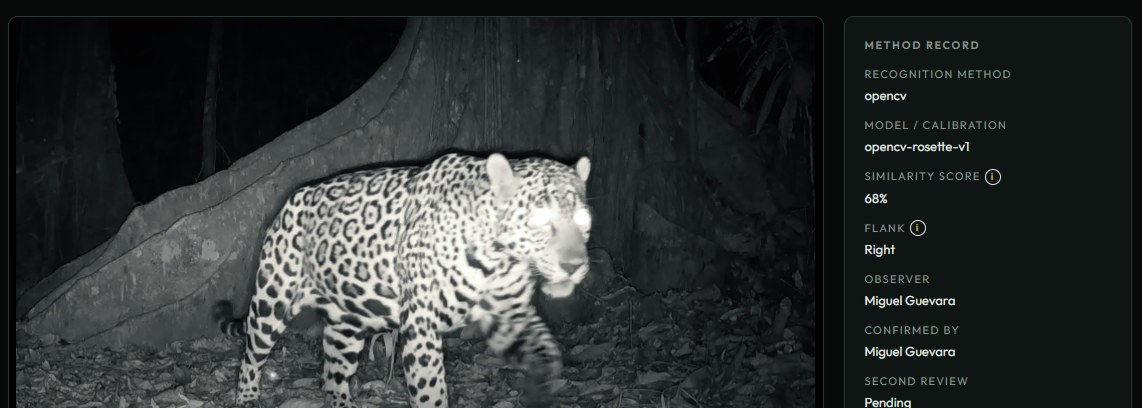
Each identity keeps a method record: the recognition method and model version, similarity score, flank, observer, first confirmer and second reviewer.
Validation.
The coat model is trained only on human-confirmed photos, plus hard negatives from matches that reviewers rejected.
Before a new version can go live, Patterns holds out the newest photos (about 20%) of every jaguar with at least three confirmed photos. The new model, the live model and the untrained fallback are each scored on exactly those held-out photos against the rest of the confirmed gallery, using top-1 accuracy, top-5 accuracy, mean reciprocal rank and mean rank of the true individual.
A new version is activated only when at least 10 held-out photos are available, top-1 improves by at least 5 percentage points, and top-5 and mean reciprocal rank do not get worse. Otherwise the live model stays in place, and smaller test sets wait for a person to review. Every version is stored, and any version can be rolled back in one click.
Reviewer agreement with suggested matches is tracked inside the app.
Data and standards.
| Format | What it contains |
|---|---|
| Camtrap DP 1.0 | The TDWG camera-trap data standard: deployments, media and observations, one observation per photo. Each observation records whether it was classified by a person or by a model. Metadata only: image files are not included. Generalized coordinates carry a coordinate-uncertainty value. Data and media licenses are stated in the package. |
| Research data export (ZIP of CSV tables) | Sightings, stations, camera locations, working periods, field visits, individuals, notes, field checks, media, detector boxes, match reviews and name proposals. |
| Capture-history matrix | Identified jaguars by calendar month (1/0), the input format for capture-recapture analysis. |
| Landscape context | On each located sighting: protected area and distance to it (OpenStreetMap, IUCN categories I–II), Costa Rica SINAC biological corridor, ESA WorldCover 2021 land cover, and slope and aspect from the Copernicus GLO-30 elevation model. |
| Versioned exports | An export can be frozen as a version so an analysis can cite exactly what it used. |
| Darwin Core Archive | Not available yet. |
Exact coordinates are available only to authorized roles; other views and short exports use generalized locations.
Dataset.
The Patterns catalog holds camera-trap photos and video, camera stations and their working periods, field visits, detections, species calls, individual identities and every review decision behind them. Field data comes from Las Oncas and Grow Jungles camera traps in Costa Rica; exact locations are withheld to protect wildlife. Each organization's photos, GPS and notes stay private to that organization, while one jaguar is one record across organizations. The size and coverage of the dataset will be published with the first data release.
What we don't claim.
- No population or density estimates yet. Patterns produces the capture histories they are built from; it does not run spatial capture-recapture.
- No automatic naming. A person confirms every identity.
- Individual recognition is jaguar-only today. Ocelot, margay, puma and Baird's tapir are planned.
- Species naming is limited to species known from Costa Rica.
- No published accuracy figures while the project is in development.
How to cite Patterns.
Grow Jungles and Las Oncas (2026). Patterns: camera-trap species identification and individual recognition. https://wildpatterns.co
When you use a Patterns data export, also cite its export version as shown on the Research data screen.
Collaborate on validation
We are looking for academic partners to help design and publish the validation study. Write to miguel@growjungles.com.
Have a camera-trap archive?
Tell us about your stations and the species you monitor. A person reads every request and writes back.